
In Venice, ACP – Palazzo Franchetti organized, from May 22 to September 30, 2021, the exhibition Massimo Campigli and the Etruscans. A Pagan Happiness, aiming to highlight the dialogue between Campigli and Etruscan art.
From May 22 to September 30, 2021, ACP – Palazzo Franchetti in Venice hosted the exhibition Massimo Campigli and the Etruscans. A Pagan Happiness, dedicated to the relationship between Massimo Campigli (Berlin, 1895 – Saint-Tropez, 1971) and Etruscan art. The exhibition stems from Campigli’s visit in 1928 to the National Etruscan Museum of Villa Giulia in Rome, later described by the artist in these words: “A pagan happiness entered my paintings, both in the spirit of the subjects and in the spirit of the work, which became freer and more lyrical.”
Campigli attributed fundamental importance to that visit for the development of the most mature phase of his artistic production. It is precisely from these words that the exhibition at ACP – Palazzo Franchetti in Venice takes shape. Curated by Franco Calarota with the general supervision of Alessia Calarota, the show presents itself as a dialogue between the master’s works and the examples from the past that so strongly inspired him. Around thirty-five works by Campigli selected for the exhibition are displayed alongside about fifty artifacts from Etruscan civilization, many of them previously unpublished and exhibited here for the first time. These were identified by Superintendent Margherita Eichberg together with scholars from the scientific committee—Leonardo Bochicchio, Simona Carosi, Daniele Federico Maras, and Rossella Zaccagnini—supported by research director Giovanni Cesarini. The exhibition also benefited from the scholarly contribution of art historian Martina Corgnati. The catalogue, published by Silvana Editoriale, includes texts by Enrico Mascelloni and Eva Weiss.
The exhibition aims to establish a profound dialogue between Campigli and Etruscan art. Campigli’s deliberately archaizing compositions, represented in the exhibition by paintings ranging from 1928 to 1966, rediscover the origins of their inspiration in the Etruscan artifacts on display, sharing atmospheres, signs, and colors in a natural affinity. As Franco Calarota emphasizes, “Starting from the famous visit to the National Etruscan Museum of Villa Giulia in Rome in 1928, one witnesses a sort of return to primordial purity in Campigli’s art, an ancient flavor made of soft colors as if painted in fresco—so similar to the way time has handed down Etruscan images—of forms shaped according to the design of votive statues or amphorae, of female figures with hourglass torsos that become abstracted into timeless images.” Two works in the exhibition, Bust with Blue Vase and Gypsies, both from 1928, clearly mark the transition toward a new figuration, which becomes increasingly evident in works such as Women with a Parasol (1940) up to Seated Woman (1961).
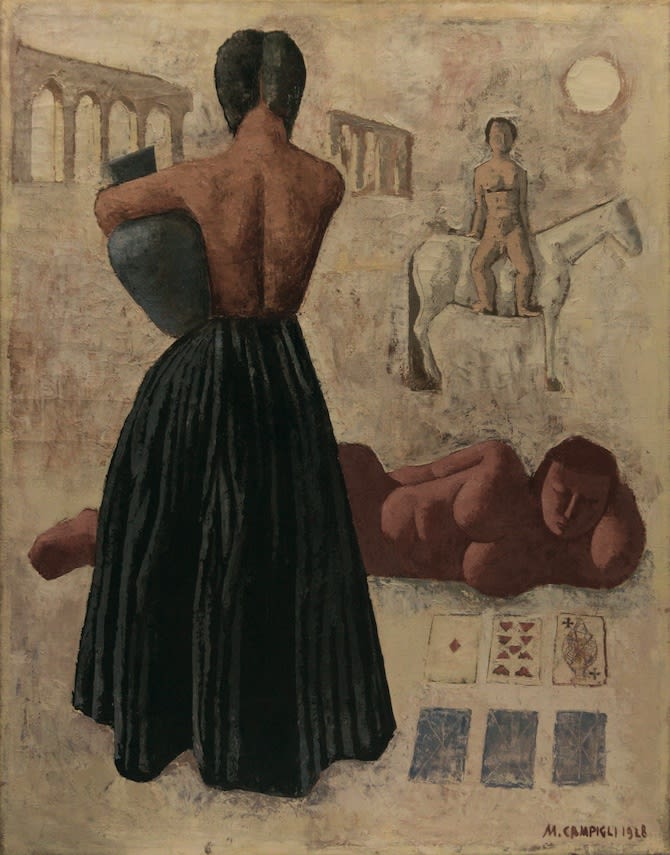
Massimo Campigli, Gypsies (1928)
The different types of artifacts on display—from vases to statuettes, from jewelry to sarcophagi—aim to trace an alphabet and a universe of connections that, beginning with general evocations, unfold into specific references throughout the exhibition’s sections: the first dedicated to the human figure, divided into men and women; the second to animals, including birds, horses, and wild animals; and finally the third devoted to forms and geometries. As mentioned, many of the artifacts are previously unpublished and come from significant recovery operations of archaeological material, including from renowned international museums, and are now under the authority of the Archaeology, Fine Arts and Landscape Superintendency for the province of Viterbo and Southern Etruria.
“We favored terracotta faces, from which the artist drew inspiration for the conception of a stereotyped portrait type detached from the direct reproduction of reality,” explains Margherita Eichberg, “bronzes and ceramic vases decorated with human (male and female) and animal figures—subjects that appear, almost as quotations, in the artist’s works; bucchero and impasto vases with geometric and curved forms that inspired the female silhouettes in some of his works; and finally jewelry, a true passion of Campigli’s.” Also on display are two precious terracotta sarcophagi from the Museo Civico di Viterbo: a female terracotta sarcophagus from the second half of the 3rd century BCE and a male terracotta sarcophagus from the late 3rd to early 2nd century BCE.
Through the revival of these expressive formulas belonging to a glorious civilization of the past, Campigli’s art reveals profound originality precisely in the coexistence of ancient splendor and modernity, immersing visitors in a dimension where time seems either to stand still or to flow calmly in unperturbed quiet. It presents a twentieth century contemporary with the most ancient ages of the Mediterranean, thus writing a very compelling chapter of what the archaeologist Massimo Pallottino defined as the “Etruscan novel,” a myth that, since the Renaissance, has continued to exert a powerful fascination from generation to generation.