
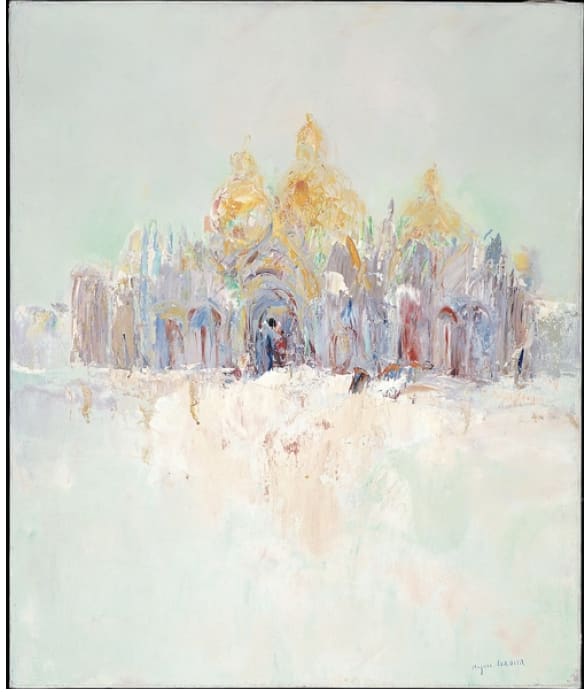
In the spaces of the Biblioteca Morandiana at ACP – Palazzo Franchetti, Fondazione Calarota presents the exhibition Jacques Cordier – Venise, dedicated to the final phase of the French artist’s painterly research, created shortly before his premature death. Curated by Marie-Isabelle Pinet, the exhibition focuses on a crucial moment in Jacques Cordier’s career, when his direct encounter with the work of J. M. W. Turner—which he was able to admire in 1971 during a visit to the Tate Gallery in London—profoundly transformed his painting.
An in-depth study of Turner’s treatment of light opened a new phase in the artist’s production, characterized by an increasingly fluid, luminous, and poetic approach to painting, which found a privileged context of expression in the evocative atmospheres of Venice, a city where he stayed frequently.
With this exhibition, Fondazione Calarota continues its research program dedicated to artists who have established a meaningful dialogue with the lagoon city. The show fits coherently within this line of inquiry and offers a further взгляд at Venice, interpreted by an artist who sought to capture not so much its form as its impression—the movement of air and water, the energy of the landscape.
Jacques Cordier (Bois-Colombes, 1937 – Lyon, 1975) trained by looking to the nineteenth-century landscape tradition. He began with drawing, for which he showed a natural inclination from a young age, and in his early ink works he mainly depicted views of Paris and its surroundings, as well as landscapes of Normandy and Brittany.
During the 1960s, however, his painting progressively opened up to color: an increasingly evident chromatic temperament emerged, accentuated by his move to Saint-Tropez with his wife Simone, and by the influence of the light of the Var region and the Mediterranean. A decisive turning point came in 1971, when Jacques Cordier and Simone visited the Tate Gallery during a stay in London. His direct confrontation with the work of J. M. W. Turner (1775–1851), a precursor of en plein air painting and tireless student of light, marked a profound shift in the artist’s creative process.
It is precisely this phase on which the exhibition concentrates, presenting primarily oil paintings on canvas that testify to a progressive dissolution of form into light: while the subjects remain recognizable, they dissolve into chromatic vibrations in which water, sky, and architecture merge. Beginning with the couple’s annual stays in Venice between 1971 and 1975, a series of works took shape in which the misty light of the lagoon became the absolute protagonist. Beyond representation, what remains is the impression: the wind swirling through the atmosphere and the ceaseless movement of the water.
Jacques Cordier was fully aware of the legacy he confronted in painting Venice, a city that had inspired artists such as Claude Monet, John Singer Sargent, and James Abbott McNeill Whistler. His compositions pay homage to these illustrious predecessors and, in works such as Près du Harry’s Bar, ideally situate themselves within the artistic and literary circles that helped define the city’s modern imagination.